The Political Illusion by Jacques Ellul
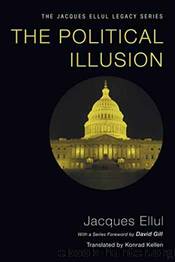
Author:Jacques Ellul [Ellul, Jacques]
Language: eng
Format: epub
ISBN: 9781606089767
Publisher: New York, Alfred A. Knopf
Published: 1966-12-31T22:00:00+00:00
1 Actually, the concentration camps in the U.S.S.R., so violently denied by Communists, are openly acknowledged by the Soviet government, which admits the story of Ivan Denisovich (Novy Mir, October 1962), but cautions against generalizing it (Literaturnaia Gazeta, November 1962). But, of course, those were Stalinist camps. There is silence on the camps still in existence today, which are pretty much the same. Still, the identity of the information and non-information mechanism regarding Nazi and Soviet concentration camps is essential.
2 The term slavery is used here in its broad sense: more precisely it is the "peonage" type of institution as studied, for example, by Gunnar Myrdal: An American Dilemma (New York: Harper & Bros.; 1944).
3 Writers who examine the conditions under which information is effective, i.e., under which it reaches and modifies public opinion, usually describe propaganda (Alfred Sauvy: La Nature sociale [Paris: A. Colin; 19571). Some of them are actually aware of it; see Leonard W. Doob's article in Daniel Katz et al.: Public Opinion and Propaganda (New York: Holt, Rinehart & Winston; 1954), and Maurice Megret: L'Action psychologique (Paris: A. Fayard; 1959), p. 127.
4 Hadley Cantril: Gauging Public Opinion (Princeton, N.J.: Princeton University Press; 1944). Strongly attacked by Alfred Sauvy (see Doob, in Katz et al.: Public Opinion and Propaganda), Cantril supplemented that law with others: "Events of unusual breadth make public opinion vacillate from one extreme to another"; "public opinion is determined much more by events than words," and so on. His argument was based on and accompanied by analyses, charts, and statistics pertaining to the war of 1914-18. Cantril has been followed by many writers; see, for example, John William Albig: Modern Public Opinion (New York: McGraw-Hill; 1956); Carl I. Hovland, Arthur A. Lumsdaine, and Fred D. Sheffield : "Experiments on Mass Communications," Studies in Social Psychology in World War II (Princeton, N.J.: Princeton University Press; 1949).
5 The "important fact" of the consequences of thalidomide did not reach public opinion as long as information remained on the honestly scientific and dispassionate level. Only the scandalous and inciting publicity of the Liege trial created public opinion on a problem which in and by itself was important, but of no interest to the average person.
6 The only problem is to know how such a fact is transmitted to public opinion, by whom, through which myths, which patterns: that is the only question. A fact no longer has objective importance. The more important a political fact is, the greater its significance, the deeper and more complex its possible interpretation, the more will it be "reworked," given certain colorations, transposed from the realm of facts to that of moral language; see Hans Speier and Margaret Otis: "German Radio Propaganda," in Daniel Lerner (ed.): Propaganda in War and Crisis (New York: George W. Stewart; 1951).
7 Obviously, the Soviet exploits of Sputnik, Lunik, etc., have had such a powerful effect on the United States because they collided with the well-established stereotype of America's superiority in the scientific and technological fields. And at the same time they aroused a certain fear.
Download
This site does not store any files on its server. We only index and link to content provided by other sites. Please contact the content providers to delete copyright contents if any and email us, we'll remove relevant links or contents immediately.
| Anthropology | Archaeology |
| Philosophy | Politics & Government |
| Social Sciences | Sociology |
| Women's Studies |
The Secret History by Donna Tartt(19128)
The Social Justice Warrior Handbook by Lisa De Pasquale(12199)
Thirteen Reasons Why by Jay Asher(8927)
This Is How You Lose Her by Junot Diaz(6900)
Weapons of Math Destruction by Cathy O'Neil(6290)
Zero to One by Peter Thiel(5816)
Beartown by Fredrik Backman(5772)
The Myth of the Strong Leader by Archie Brown(5517)
The Fire Next Time by James Baldwin(5458)
How Democracies Die by Steven Levitsky & Daniel Ziblatt(5227)
Promise Me, Dad by Joe Biden(5161)
Stone's Rules by Roger Stone(5092)
A Higher Loyalty: Truth, Lies, and Leadership by James Comey(4974)
100 Deadly Skills by Clint Emerson(4936)
Rise and Kill First by Ronen Bergman(4803)
Secrecy World by Jake Bernstein(4762)
The David Icke Guide to the Global Conspiracy (and how to end it) by David Icke(4730)
The Farm by Tom Rob Smith(4518)
The Doomsday Machine by Daniel Ellsberg(4497)
